Showing posts with label Mohamed Farhi. Show all posts
When I was a first-year master's student, I volunteered for undergraduate exam proctoring. I was asked to write a report on my experience.


            The exam of Advanced Multilingual Translation course, taught by Professor Berjaoui, was held for semester five students on December 12, 2015. It took place between 10:00 am and 12:30 pm. A team of six master's students, including me, volunteered for exam proctoring, which was supervised by Professor Berjaoui.

            We met at 9:30 am in the office of the English Department, as requested by Professor Berjaoui, who was very kind and welcoming in offering the proctors light breakfast meals during the meeting. In this pre-proctoring meeting, we discussed issues related to student-proctor relationship and received relevant instructions from our professor. At 9:50 am, we headed for the exam room. As soon as the students took their seats, Professor Berjaoui introduced us to the examinees and we greeted each other. Then we distributed the exam papers, and the examinees immersed themselves in the task.

Despite the large number of examinees, about two hundred, and the big size of the room, the six-member team of proctors, with the help and supervision of Professor Berjaoui, scattered throughout the room not only to ensure the integrity of the exam but also to offer immediate help to the examinees, such as handing them correction pens and extra sheets and/or clearing any confusion. When the first hour was over, the first group of examinees left and the second entered. At 12:30 pm, the exam finished. For the first and second group alike, the overwhelming majority of examinees were serious, friendly and helpful. The event was not without very few funny incidents such as one examinee trying to seek assistance in answering the exam from one of the proctors only to receive the suggestion of asking the professor for help, which he or she refused with a smile and went back to the task.

            When the exam ended, the professor and the proctors went back to the department office where they first met. During this brief, post-proctoring meeting, we discussed the proctoring experience with the professor. We were glad to know that he was satisfied about our performance. As to my case, this experience was memorable and life-changing. It was the first time I step out of the world of studentship and into the world of professorship. Besides the great experience of proctoring tens of students in an amphitheater, throughout the event and especially during the two meetings, Professor Berjaoui gave the proctors invaluable advice on the world of university teaching. In brief, thanks to Professor Berjaoui’s expertise and professionalism, the proctors’ work and the examinees’ maturity, the event was a success and, as a volunteer, I had a life-changing experience.


The Gender Studies Research Group hosted a seminar on “Women in Politics” in May 2, 2016, moderated by Pr. Soumaya Belhabib with the participation of Pr. Aili Mari Tripp as a guest speaker from the University of Wisconsin-Madison, USA, and Pr. Naima Benlarbi from Ibn Tofail University, Kénitra, Morocco. The moderator of the seminar, Pr. Soumaya Belhabib, gave the opening talk in which she expressed her thanks to the guest speaker and Pr. Naima Benlarbi for participating in the seminar and to the audience for their attendance. After that, she discussed the importance of the topic of “Women in Politics” in the MENA region and its relevance to the aims of the Gender Studies Research Group, including the promotion of ethical principles of justice, equity, human rights and democracy through education and research. She then gave the floor to the first speaker, Pr. Aili Mari Tripp.


Pr. Aili Mari Tripp delivered a presentation entitled “Women’s Political Representation in the Arab Maghreb,” which is part of the research she is undertaking on gender and politics in the MENA countries. The research question her presentation is centered on is as follows: “Why have Maghreb countries increased [women’s] political representation faster than other MENA countries?” She started her presentation with a discussion of the differences and commonalities between Maghreb countries. For instance, some of the commonalities between the Maghreb countries, according to Pr. Aili Mari Tripp, are the shared Maliki Islamic and French jurisprudence and the centralized state control over the legal system. Next, she moved to discuss her proposed answer to the aforementioned research question, that is, the factors behind the difference between the Maghreb and the rest of the MENA region in increasing women’s political representation. Moreover, Pr. Tripp questioned the treatment of oil production as a factor that explains the difference in women’s political representation in the MENA region.


After Pr. Tripp’s presentation, the floor was given to Pr. Naima Benlarbi who delivered a presentation entitled “The Political Rights of Moroccan Women.” Her presentation was divided into two parts. The first part argued for the right of Moroccan women to politics according to the sources of Islam while the second part did so according to “modern law (mainly the Constitution) and Moroccan Records of History on women’s participation.” After defining the terms politics and rights, Pr. Benlarbi moved on to discuss how the situation of Women in the Arabian Peninsula was improved with the coming of Islam, citing as evidence Ayah 71 of Surah 9 and Ayah 13 of Surah 49. Next, she discussed the idea that Islamic historical records include instances of women’s participation in the political life, such as the right to Bai’ah, using this as a supporting evidence for Islam's compatibility with women's political participation. Out of this discussion on women’s political participation throughout the history of Islam, Pr. Benlarbi concluded that “there are at least no Qur’anic verses that clearly prevent women from occupying important positions even in government especially those of leadership in Islam,” adding, “but there are some positions which raise some controversy.” Other sub-topics that Pr. Benlarbi touched upon are the questions of women’s leadership, female judges, and women in the presidency or as heads of state, citing Qur’anic verses like the story of Queen of Sheba as well scholars’ interpretations and opinions of these issues like Fatema Mernissi’s and Sheikh Al-Quaradaoui’s. After that, she moved to “the case of modern law in Morocco,” in which she discussed Moroccan women’s relation to politics in the Moroccan historical and contemporary records, concluding that “today, the 2011 constitution enshrines the principles of cultural and linguistic pluralism, individual rights and the equality of citizens – including of women and men.”


After the delivery of the two presentations, the floor was given to the audience, comprised of undergraduate and graduate students and some professors, to address their questions and comments to the speakers. Students’ comments and questions were diverse and plentiful. Their engagement in the seminar showed their enthusiasm for the issue of gender and its relation to Islam, an enthusiasm nurtured by similar academic discussions.


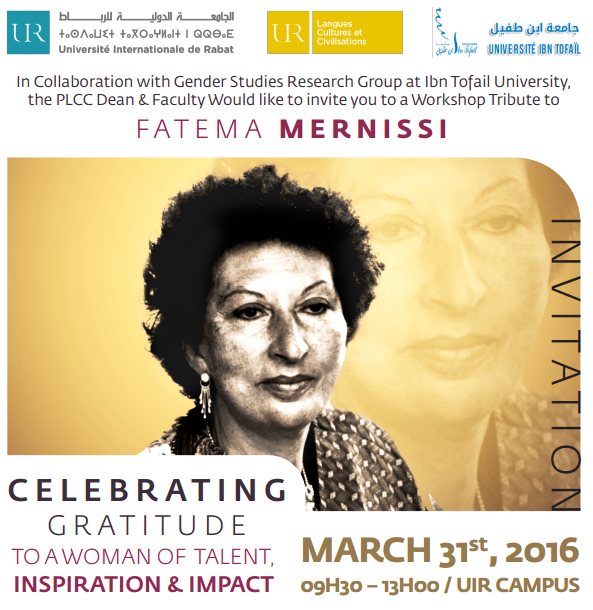
In Collaboration with the Gender Studies Research Group at Ibn Tofail University, the PLCC Faculty organized a workshop in tribute to Fatema Mernissi in March 31st, 2016 at the UIR campus. The workshop was divided into four parts: the opening session and welcoming speech (09:30 to 10:00), "Panel 1: Testimonies (10:00 to 10:50)," "Panel 2: A book of her own: Rewriting glocal feminism (11:00 to 12:00)," and "Panel 3: A dream of her own: Women’s daily battles (12:00 to 13:00)."

The opening session and welcoming speech (09:30 to 10:00) was initiated by Mr. Najib Mokhtari from UIR, who welcomed the participants and guests from UIR and ITU and read a short poem he composed in memory of Fatema Mernissi. After that, he gave the floor to Mr. Abdelaziz Benjouad, the vice president of research and development at UIR, who gave an opening talk on behalf of the president of UIR. Next, Ms. Hakima Fassi Fihri, Head of International Relations and Partnerships at IUR, took the floor, welcoming the participants and guests, and clarified the context of the workshop, that is the International Women’s Day of the 8th of March. She then gave the floor to Ms. Soumaya Belhabib, the Coordinator of the Gender Studies Research Group at ITU, who closed the opening session with a talk on the academic contribution of Fatema Mernissi and its inspirational impact on current and would-be scholars. In addition, she stated that the workshop dedicated to Fatema Mernissi is part of the mission of the Gender Studies Research Group at ITU, which is to promote “ethical principles of justice, equity, human rights and democracy through education and research in the realm of gender.” Prof. Soumaya Belhabib concluded this speech by expressing her thanks to the people who made this event possible, and welcomed the participants and guests. After that, Mr. Najib Mokhtari played a video clip that highlights the achievements of some great Moroccan and non-Moroccan women like Nawel Al Moutawakel, Aicha Ben-Chenna and Leola N. King.


“Panel 1: Testimonies (10:00 to 10:50)” was moderated by Mr. Mohamed El Himer, Head of the Multidisciplinary Studies Research Laboratory at ITU. In this first panel, the floor was given to speakers from different backgrounds who had a relationship, whether academic, personal or both, with the late Fatema Mernissi. The first speaker was Ms. Asmae Benadada, Sociologist at Sidi Mohamed Ben Abdallah Dhar El Mehraz, Fez. In a talk in Standard Arabic, she paid tribute to Fatema Mernissi, listing her admirable personal and academic traits and intellectual achievement. She also expressed how inspiring Fatema Mernissi was for her academic, intellectual and feminist journey, and how influential she is in the field of sociology and gender studies. Next, the floor was given to Ms. Dima Droubi, a writer, who told her own story with the works of Fatema Mernissi, and how these works inspired her to write her novel “La Sultane du Caire.” The floor was then given to Ms. Rachida Guelzim, a textbook writer and teacher trainer at the British Council, Rabat, who told some of her personal stories with the late Fatema Mernissi, which were full of funny and inspirational anecdotes. Ms. Maria Moukrim, web editor of Febrayer.com, also told her intellectual story with Fatema Mernissi, saying that Fatema Mernissi used to encourage female journalists to pursue their intellectual and feminist aspirations. After the talk of Ms. Maria Moukrim, Ms. Dominique Benbrahim, public affairs officer in the US embassy of Rabat, and Ms. Damia Benkhouya, member of the Regional Council for Human Rights in Rabat-Kenitra, among others, paid tribute to Fatema Mernissi through their talks that recount their relationships with Fatema Mernissi, personal, academic, or both.


The second and third panels as planned in the flyer were combined in one panel, which was moderated by Mr. Mustapha Bencheikh, Professor & Director of the PLCC at UIR, and Mr. Najib Mokhtari, Associate Professor in the same university. The opening speech was delivered by Mr. Mustapha Bencheikh, in which he expressed his admiration for Fatema Mernissi and appreciation of the talks given in the first sessions. Mr. Najib Mokhtari then gave the floor to Ms. Raja Rhouni, Professor at Chouaib Doukkali University, El Jadida, who gave a talk entitled “Decolonizing Feminism” based on her doctoral research on the works of Fatema Mernissi. In this talk, Ms. Raja Rhouni discussed the secular and Islamic works of Mernissi through Marnia Lazreg’s concept of decolonizing feminism. The second talk was given by Aili Mari Tripp, a Professor at the University of Wisconsin, Madison, and was entitled “Fatema Mernissi’s Feminism Goes West,” through which she highlighted the international influence of Fatema Mernissi, who was considered outside Morocco the spokesperson of third world women. After that, the floor was given to Mr. Mourad Mkinsi, Professor at Ibn Tofail University, Kenitra, who paid tribute to Mernissi through a talk entitled “Fatema Mernissi and the Challenge of Equality.” Prof. Mkinsi stated that Mernissi had a strategic approach in her campaign for equality, always considering how her works would be received by readers and how they would influence gender politics in Morocco. He added that she combined academic inquiry with activism, making her a true organic intellectual. The last talk was delivered by Mr. Amine Benhallam, director of Fatema Mernissi Youth Think Tank at ILCS, Rabat, under the title of “Fatema Mernissi et les sciences sociales phronétiques.” In his talk, Mr. Amine Benhallam highlighted, among other points, Fatema Mernissi’s tenacity through the character of Aisha, the central figure of her book The Veil and the Male Elite.

In conclusion, the workshop remained faithful to its aim; it did indeed pay tribute to a figure as influential as Fatema Mernissi. Except for the absence of the discussion part, the workshop was well-organized with participants, writers and academics, from different backgrounds but with a shared admiration for Fatema Mernissi as a person and intellectual. 
The study of language variation or speakers’ language choices in sociolinguistics has been conducted using different approaches or a combination of some of these approaches. This essay reviews three approaches to language variation, namely those using the notions of social class, social network and community of practice, considering their strengths and weaknesses as well as the relation between them.

Social class is one of the long-established approaches to language variation in sociolinguistics. When using social class, sociolinguists study language variation at the level of large social groups (Meyerhoff, 2006, p. 155). Generally, the use of social class in the study of language variation has helped sociolinguists find systematic correlations between class and speakers’ language choices. In so doing, it helped them make conclusions about the meanings speakers attach to different linguistic variants (p. 183). Despite that, the use of the concept of social class in sociolinguistics has received much criticism, and, as such, it has largely been substituted by other approaches (Marshal, 2004, p. 23; Meyerhoff, 2006, p. 182). The criticism levelled against the use of social class centers on its abstractness (Meyerhoff, 2006, p. 182), and large-scale application that leaves little room for analysis on the level of the individual (Marshal, 2004, p. 23).

The concept of social network was first used in social anthropology where its characteristics and conditions were specified, namely, multiplexity, frequency, density, and centrality (Marshal, 2004, p. 19). The use of social network in sociolinguistics as an analytic tool for language variation grew out of dissatisfaction with the approach of social class (Marshal, 2004, p. 23). Lesley Milroy was the first to apply this concept to the sociolinguistic study of language variation. One of the major differences between the use of social class and social network as analytic tools is that the former studies variation on the level of large social groups while the latter does so on the level of the individual and their interactions (p. 26). Milroy defines the concept of social network as used in sociolinguistics as “the relationships [individuals] contract with others . . . [reaching] out through social and geographical space linking many individuals” (as cited in Meyerhoff, 2006, p. 184). Her work in Belfast, which studied language innovation and maintenance, is a good example of the application of social network to the study of language variation (Wei, 2001, p. 894). Milroy’s central argument in this study is that there are correlations between the strength of a speaker’s network and his or her language choices, conscious and unconscious (Marshal, 2004, p. 27). In particular, Milroy maintains that the more close-knit a speaker’s network is the more faithful he or she is to vernacular norms (p. 28) and vice versa (p. 32).

The use of social network to analyze language variation received criticism in the sense that it is unable to account for loose-knit networks since it is mainly the upper and lower classes that form close-knit networks while the middle-class speakers tend to form loose-knit networks because of their high geographical and social mobility (Marshal, 2004, p. 32). Moreover, Milroy posits that the frameworks of social class and social networks are not in opposition. Rather, considering them as complementary may result in a more rigorous analysis (Marshal, 2004, p. 33; Meyerhoff, 2006, p. 185). As such, Milroy argued for connecting the two through Thomas Højrup’s concept of life modes (Meyerhoff, 2006, p. 35), which is based on the idea that different modes of production and consumption lead to different modes of life. In linking this concept to the concept of social network, Milroy maintains that these different modes of life, that stem from different modes of production and consumption, lead to different social networks, and these in turn lead to variation in linguistic behavior (Marshal, 2004, p. 36).

In the same way the use of social network in sociolinguistics grew out of dissatisfaction with the notion of social class, the concept of community of practice was introduced to the study of language variation in the beginning of the twentieth-first century as a result of dissatisfaction with the notion of social class and social network (Marshal, 2004, p. 36). While Eckert, who introduced the term to sociolinguistics, does not deny the importance of the concepts of social class and social network, she argues that the concept of community of practice has more analytic power in that it focuses on “the mutually constitutive nature of the individual, group, activity, and meaning” (as cited in Marshal, 2004, p. 36). In other words, in a community of practice, people gather around a joint enterprise and have mutual engagement, and, in doing so, they develop a shared repertoire, part of which is a shared way of using language (p. 36). As such, the concept of community of practice goes beyond that of social class in that the community may comprise people from different social classes, and goes beyond that of social network in that the community may not necessarily be dense and close-knit (p. 36). In her application of this concept, Eckert found that the more speakers are involved in their community of practice, the less linguistic innovations they adopt, a result that stems from their relatively high engagement in their community of practice in comparison to their local social networks (p. 39).

            In conclusion, throughout its history, the study of language variation has been conducted using different approaches, most influential of which are the approaches centered on the notions of social class, social network and community of practice. The use of social class attempts to show the correlations between the social classes of speakers and their language choices. While this approach has provided much insight into language variation, it has been criticized as too abstract. The concept of social network was borrowed from anthropology by sociolinguist Milroy out of dissatisfaction with the concept of social class. Applications of this concept show that, as opposed to loose-knit networks, close-knit social networks tend to resist linguistic innovations. Later on, Milroy argued for treating the concepts of social class and social networks as complementary, and did so through integrating the concept of life modes with that of social network. However, in the beginning of the twentieth century, it was argued that the concept of community of practice is more adequate for the study of language variation than the previous concepts in that language users tend to be influenced more by their communities of practice than by their social classes or social networks.


References

Marshal, J. (2004). Theoretical Background and Previous Research. In Language Change and Sociolinguistics: Rethinking Social Networks. Palgrave Macmillan.
Meyerhoff, M. (2006). Social Class. In Introducing Sociolinguistics. New York: Routledge.
Meyerhoff, M. (2006). Social networks and Communities of Practice. In Introducing Sociolinguistics. New York: Routledge.
Wei, L. (2001). Leslie Milroy. In R. Mesthrie (Ed.), A Concise Encyclopedia of Sociolinguistics. Elsevier.


Desrues, T., & Nieto, M. J. (2009). The development of gender equality for Moroccan women – illusion or reality? Journal of Gender Studies, 18(1), 25-34.


            The article under review is written by Thierry Desrues and Juana Moreno Nieto and published in the Journal of Gender Studies by Routledge. As its title suggests, the aim of the article is to examine whether the development of gender equality in Morocco is an illusion or reality. In the abstract and introduction, the authors further clarify this aim, stating that they attempt to analyze the extent to which the situation of Moroccan women has improved and whether there is “real change” (Desrues & Nieto, 2009, pp. 25-26). In the abstract, the authors state their two findings. The first is that “although real progress has been made over the last 50 years, there is still much more to be achieved.” The second is that “there are indications that the incipient participation by women in the public sphere too often continues to reproduce schemes of subordination” (p. 25). Considering social change as a multidimensional process, the authors divide their analysis into four sections, each dealing with one broad dimension. This review keeps the same organization; a summary and critique of each section is provided before moving to the following section.

Socio-demographic variables of change
            The first section, entitled “Socio-demographic variables of change,” includes three subsections, each analyzing one socio-demographic variable. First of all, it should be noted that the authors moved directly to the analysis without providing a literature review, given that they are speaking of findings, hence the need for a review of previous findings. Concerning the section in question, the authors open it with the broad, unsupported statement that “wide consensus exists regarding the socio-demographic variables that play a key role in identifying the processes of social change” (p. 26), to justify their choice of the three variables they are about to analyze. These socio-demographic variables are “access to education, the postponement of marriage and declining average number of children per women, as well as the effects that these phenomena have on the concept of family” given that they are “some of the most relevant factors for understanding the situation of women” (p. 26).

            In the subsection entitled “Education: the driving force behind change,” the authors use statistics from official reports and other references about “schooling and diminishing drop-out rates” in K-12 and higher education and compare the percentages of the two sexes in the post-independence as well as contemporary Morocco (pp. 26-27). Concerning contemporary Morocco, the statistics cited by the authors show that there is a very insignificant discrepancy between the sexes in terms of access to education, especially in urban areas (pp. 26-27). The authors conclude, “the progress made since independence in terms of education is real, but continues to be insufficient, especially with regard to women in rural areas” (p. 27). It should be noted that this subsection has few weaknesses. For instance, contrary to the authors’ idea that education “constitutes a true break with the past” (p. 26), K-12 and higher education in Morocco, being unsecular, is arguably used for patriarchal indoctrination. In other words, Moroccan girls have equal access to education, but they are not educated to believe in total gender equality. Another weakness is that the authors consider the variables of access to jobs and political participation as merely derivatives of the variable of education. Instead of treating them as separate variables, given their importance, they very briefly analyze them at the end of the subsection on education. 

            In the second subsection, entitled “Changes in family size and composition,” the authors use family size and composition as the second socio-demographic variable for evaluating the development of gender equality in Morocco. Using statistical evidence, the authors affirm that there is a shift “from large to small families” and “from multigenerational to nuclear households” as well as a decrease in the number of children per woman, concluding that such shifts indicate “the growing power of women as wives” (p. 28). However, since the aim of the article is to evaluate gender equality in Morocco, it should be noted that while changes in family size and composition may be a sign of the improvement of Moroccan women’s situation, as the authors state, these changes are not necessarily a sign of the rise of equality-based families. Nuclear families are rising, but there remains the question of whether these families are based on the principle of complementarity or equality, a question a quantitative approach may not adequately answer.

            In the third subsection, entitled “The postponement of marriage,” the authors use the postponement of marriage as a socio-demographic variable for evaluating the development of gender equality in Morocco. Using statistical evidence for the growing tendency among Moroccan young people to postpone marriage, the authors develop the idea that such tendency indicates that the institution of marriage in Morocco is being questioned. Yet, the postponement of marriage does not mean “[the] norm is being questioned” (p. 28), nor is it a sign of the development of gender equality. Rather, arguably, the phenomenon is largely a result of socio-economic factors, mainly education and unemployment, the latter of which is considered by the authors as merely part of “other factors” (p. 29). The authors end the subsection with a statistics-based claim without evidence in terms of citation or primary research, only to conclude that “women continue the social trend of marrying older men. If this is the case, it would suggest that hegemonic structures are still being reproduced on some level, where the husband’s authority is grounded in age rather than as solely a product of his gender” (p. 29). Contrary to this statement, what gives Moroccan males their authority in marriage is not their old age but the very status of being an adult male.

Feminist mobilization
            Having analyzed the three socio-demographic variables, the authors move on to the second section entitled “Feminist mobilization.” In this section, they provide a brief review of feminist mobilization in post-independence and contemporary Morocco. The section opens with the idea that the limited access to education by women since independence paved the way for the emergence of educated female elite, some of whom became feminist activists organized under associations like the Democratic Association of Moroccan Women (ADFM) and the Women’s Action Union (UAF) (p. 29). After that, the authors discuss the role of current women’s associations in continuing the feminist battle and their interactions with international feminist and human rights organizations (p. 29). The section closes with a discussion of the achievements of Moroccan feminist associations, some of which are that they managed to make women’s right a public issue rather than a taboo and that their mobilization was appropriated by the king who reserved 30 seats for women from a national list for the elections to the Chamber of Representatives in 2002 and launched the drafting of the new family code in 2003 (pp. 29-30).

The new Family Code
            In the third section, entitled “The new Family Code,” the authors discuss the strengths and limitations of Morocco’s latest family code (2004). They cited one list of the achievements and another of the limitations of the family code (pp. 30-31). The authors affirm that the positive changes brought by the family code are many, at least in theory, but the code has serious limitations (p. 31). The limitations concern legal guardianship of children, repudiation, separation by compensation, inheritance, polygamy, and toleration of certain cases of underage marriage (p. 31). The section closes with a discussion of the difficulties of application of the new code and resistance from conservatists (p. 31).

Opinions about women’s place in society
            The fourth and last section, entitled “Opinions about women’s place in society,” is motivated by the idea that “the extent to which the situation of women in Morocco has changed needs further interrogation,” and that “a subjective dimension should be considered” (p. 31). To this end, the authors use data from the World Values Survey (2001) with the aim of taking into account Moroccans’ opinion about women’s place in society. After summarizing the statistical data, the authors conclude that “although the incorporation of women in the public sphere does not meet with complete rejection, women remain perceived as subordinate to men and their incorporation is in turn conditioned by this subordination” (p. 32).

In the conclusion, the authors provide a summary of their analysis, but it is a summary that highlights some conclusions while overlooks some major ones reached in the analysis, such as the ones on political participation and postponement of marriage (p. 32). The summary is headed by the statement: “In spite of the progress made since independence, the situation of women in Morocco is far from egalitarian” (p. 32). The authors end the article with recommendations for studying “the newly articulated situation” of Moroccan women “in a context such as Morocco that is replete with uncertainties” (p. 32).

To summarize this  review, it can be said that the article is based on the truism that “although real progress has been made over the last 50 years, there is still much more to be achieved” (p. 25), which is true for most Muslim-majority and other third world countries. Truisms are of course worthy of study, but this article provides a very modest analysis of this truism, which may be ascribed to its heavy use of statistics as well as the weaknesses discussed throughout this review and summarized here. The authors speak of findings, but they did not provide a literature review of previous findings on gender equality in Morocco. Besides, they failed to justify their choice of the selected socio-demographic variables. Added to these are the several weaknesses in the subsections on education, family size and composition, and postponement of marriage.


McRobbie, A. (2008). Young women and consumer culture: An intervention. Cultural studies, 22(5), 531-550.


McRobbie's "Young Women and Consumer Culture: An Intervention" is a journal article published by Routledge as part of the Cultural Studies journal, volume 22, issue 5. The article is divided into four sections: ‘The perils of ‘commodity feminism,’ ‘Feminism and consumer culture,’ ‘Feminism and Sex in the City,’ and ‘Pole dancing for pre-teens?’. The first section entitled ‘The perils of ‘commodity feminism’ is presented as an introduction, in which McRobbie lists the main topics she intends to deal with and her three objectives.

The first objective of the McRobbie’s article is dealt with in the section entitled ‘Feminism and consumer culture’. In it, she provides a critical review of the general features of feminists’ responses to consumer culture, with a particular focus on her works. Focusing on television and magazines, the authors criticizes feminist writings in the last decade as being focused more on feminine pleasures than on the commodification of femininity. More problematic according to her is the fact that feminist critics became complacent as they noticed feminism becoming part of the media. After that, McRobbie moves on to self-critique her own response to feminism in relation to consumer culture during the 1990s. In particular, the author criticizes the failure of her writings to consider the "elements of patriarchal power or the heterosexual matrix … [that were] quickly able to exploit, and duly benefit from, the emerging post-feminist language of personal choice, freedom and independence which the magazines of the 1990s endorsed." Apart from this, McRobbie criticizes how her writings overlooked the restrictions put on feminist editors working in media institutions. She also admits her inattentiveness to "the brutality of racial and sexual exclusions" in favor of white, heterosexual identities. Finally, she summarizes her critique of feminist studies in the last decade, including her own, in the idea of the failure to apply academic scholarship to the social and cultural world.

Having critically reviewed previous feminist writings on consumer culture, including her own, McRobbie moves in the next section, entitled ‘Feminism and Sex in the City,’ to review and comment on feminist writings on the US television series Sex in the City. The main purpose of this section is to critique the obsessive consumption this television series promotes and feminists' inattentiveness to this problematic. McRobbie refers to the latter as 'complicitous critique', a pro-capitalist attitude to the series, one that positions feminist critics as fans of the series rather than as critical of it, making them overlook, intentionally or unintentionally, “the perils of commodity feminism.” More specifically, McRobbie argues, through a close analysis of the series, that Sex in the City, which was largely endorsed by feminists, leads to the undoing rather than the promotion of feminist ideals, to “gender retrenchment and the undoing of feminism,” to use McRobbie’s words. Specifically, the author argues that consumer culture is provided as a way to come to terms with, or escape from, the excess of femininity in the post-feminist era, and  that “popular entertainment […] re-vitalize[s] existing patriarchal relations of power and domination by securing anew the consent of women to existing social and political arrangements.”

The third objective of McRobbie’s article, which is dealt with in the last section entitled ‘Pole dancing for pre-teens?’, is to draw attention to the way consumer culture extends the requirement of normative post-feminist femininity to pre-teen girls. Media and consumer culture, argues McRobbie, treats the child not as a child but as a girl only to make them aspire to the ideal femininity, a subject position that can only be attained through the kind of consumer behavior promoted, making them very important, current and future, consumers par excellence. McRobbie also brings to her discussion an opposing voice, that of Sarah Banet-Weiser, which welcomes the appropriation of feminism by media and thinks of it as ‘not a problem’. McRobbie criticizes this attitude in that it overlooks the fact that media gives voice only to (neo)liberal, pro-capitalist feminism, the kind of feminism that tends to tolerate consumer culture and overlook its perils. McRobbie ends this section as well as the article by restating her main objective behind this paper, which is “to re-activate the terms of feminist critiques of consumer culture so as to address the increasingly powerful role played by these forces for young women, for girls, and also for pre-teen girls.” Such objective, adds McRobbie, cannot be achieved without the resuscitation of feminist anti-capitalism coupled with psychoanalytical thinking.

To conclude, in this article, McRobbie attempts to draw attention to the danger consumer culture poses to feminist ideals, namely that of gender retrenchment and the undoing of feminism, taking the US television series Sex in the City as a case study. McRobbie develops this argument through three parts: first, a critique of feminists’ responses to consumer culture including her own, second, a critique of feminists’ writings on Sex in the City and a comment on its promotion of compulsive consumerism, and, third, a critique of involving pre-teens in this post-feminist consumer culture. 

عقد مختبر اللغة والمجتمع، التابع لكلية الآداب والعلوم الإنسانية بجامعة ابن طفيل بالقنيطرة بمدرج المناظرات زوال يوم الثلاثاء 15 مارس 2016، ندوة بعنوان «ثقافة التربية والتدريس» (The Culture of Education and Teaching). تعد هذه الندوة الثالثة ضمن سلسلة من الندوات والمناظرات بعنوان «الثقافة المغربية: التراث و(ما بعد) الحداثة»، حيث تمحورت الندوة الأولى حول الربيع العربي والثانية حول الثقافة الإسلامية وسؤال النوع. وتجدر الإشارة إلى أن هذه السلسلة تتميز بالتعددية اللغوية حيث تتاح للمشاركين والحضور حرية الاختيار بين الإلقاء باللغة العربية، أوالفرنسية، أوالإنجليزية.
نظمت الندوة بتأطير من الدكتور عبد القادر عبو، رئيس شعبة الدراسات الإنجليزية بنفس الكلية، وبمشاركة كل من الدكتور أبو عبد القادر حسن أستاذ بالمدرسة الوطنية العليا للفنون والمهن بمكناس، والدكتور محمد ملوك أستاذ بكلية علوم التربية بالرباط، والدكتور أحمد الفرحان أستاذ الفلسفة بجامعة ابن طفيل. ناقش الأساتذة المشاركين الدكتور توفيق الله أفكينيش، أستاذ بشعبة اللغة الإنجليزية بنفس الكلية. هذا وافتتح الندوة الدكتور عبد القادر عبو بتقديم الأساتذة المشاركين وشكرهم، وكذا الحضور، على حضور الندوة. كما عبر عن أهمية موضوع ثقافة التربية والتدريس في خضم الأزمة التي يعرفها النظام التعليمي المغربي. بعدها أعطى الانطلاقة للنقاش بإعطاء الكلمة للمتحدث الأول، الدكتور محمد ملوك.

ألقى الدكتور محمد ملوك عرضا باللغة الإنجليزية بعنوان “I teach, but do they learn?: Teachers’ Intentions vs. Students’ Expectations” (أدرس، لكن هل يتعلمون؟: نوايا الأساتذة مقابل توقعات الطلبة). افتتح الدكتور عرضه بمقدمة شخص فيها إشكالية العرض، وهي المعيقات التي تحول دون تحقيق الهدف الجوهري للعملية التربوية: نجاح المدرس في تدريس ما يجب تدريسه ونجاح المتعلم في تعلم ما يتم تدريسه. لكن الحصيلة، يضيف الدكتور، في الغالب ما تكون غير مرضية رغم كل الإصلاحات التي تدعي أنها تضع المتعلم في جوهر العملية التربوية. بعدها مر الدكتور إلى التساؤل عما إذا كانت المشكلة مشكلة تدريس أو تعلم أو كلاهما.  ثم أتبع هذا التساؤل بالفرضية التالية: رغم جودتها، تتعارض المناهج التعليمية الحالية مع التصور الذي يمتلكه الأستاذ والمتعلم (والمجتمع) عن التربية، والذي ينتج عنه تعارض بين نوايا الأساتذة وتوقعات الطلبة (التدريس مقابل التعلم). انتقل الدكتور بعدها إلى التعريف بهذه النوايا والتوقعات. فذهب إلى أن نوايا الأساتذة تكمن في تدريس البرامج المقترحة والحرص على تغطية كل المحاور وتقييم مدى نجاح الطلبة في تعلمها عن طريق الامتحانات. أما توقعات المتعلمين فتكمن في تعلم ما يتم تدريسه والنجاح بغية الحصول على الشهادة.
بعد ذلك انتقل إلى تعريف ماهية التربية والبيداغوجية ومناقشة بعض فلسفات التربية مثل ما يسمى بالفلسفة الدائمة أو الأبدية (Perennialism) والواقعية (Realism) والماهوية (Essentialism) والمثالية (Idealism) والتقدمية (Progressivism) والبراغماتية (Pragmatism) والبنائية (Constructivism). كما فصَّل في طبيعة عملية التعلم (The learning process) ومفهومي التحفيز والتعزيز. وأشار كذلك إلى أهمية مراعاة الفروق الفردية بين المتعلمين. أنهى الدكتور عرضه بخاتمة مفتوحة على شكل اقتباسات لها علاقة بثقافة التربية والتدريس.
بعد أن فرغ الدكتور محمد ملوك من إلقاء عرضه، أخد الدكتور عبد القادر عبو الكلمة، شاكرا الدكتور على العرض القيم ومعلقا عنه بتساؤل عن السبب الذي جعل هؤلاء المدرسين يحملون هكذا نوايا وجعل المتعلمين يحملون هكذا توقعات، وعلى من يجب أن يقع اللوم، مضيفا أن الإجابة تكمن في ثنائية الثقافة والتربية، وهو موضوع الندوة التي لازالت في بدايتها، على حد قوله.

بعد ذلك أعطى الدكتور عبد القادر عبو، مؤطر الندوة، الكلمة للدكتور أبو عبد القادر حسن، أستاذ بالمدرسة الوطنية العليا للفنون والمهن بمكناس، الذي ألقى عرضا باللغة الفرنسية بعنوان “? Programmes Universitaires et Société : Quel impact” (المناهج الجامعية والمجتمع: أي تأثير؟). فقسم هذا العرض إلى خمسة محاور: مقدمة وملخص الوحدات (Sommaire des Modules) وتوزيع الوحدات (Répartition des Modules) والنتائج (Résultats et Constatations)، على مستوى المحتوى والبيداغوجيا، وخاتمة. بعد مقدمة قصيرة حول منزلة اللغات ضمن البرامج التدريسية وعلاقتها بباقي المواد التدريسية، انتقل الدكتور إلى جوهر عرضه، وهو تحليل لمحتوى برنامج شعبة اللغة الإنجليزية، سلك الإجازة، في جامعة مولاي إسماعيل بمكناس، بغرض إيجاد مكامن الخلل فيه. فوجد الدكتور أن الخلل يكمن في كون البرنامج الجامعي قيد التحليل يعطي أهمية للمهارات اللغوية على حساب المهارات النقدية والثقافية والفنية، وأن هذا الخلل يعكس الانقسام التقليدي بين اللغة ودورها في المجتمع. وختم الدكتور عرضه بفكرة أنه يجب وضع مناهج دراسية متناغمة وحاجيات المجتمع، كما يجب تقليص الفجوة بين الطالب والأستاذ.

بعد انتهاء العرض، أخد الدكتور عبد القادر عبو الكلمة حيث تساءل، في علاقة مع العرض الأخير، عن مدى حضور «الثقافة المغربية والتربية المغربية [في] هذه المناهج كمضمون وكمناهج في حد ذاتها». كما أضاف أن إشكالية ثقافة التربية والتدريس هي «إشكالية ثلاثية الأضلاع … النظام  والأستاذ والطالب أو التلميذ». وتساءل ما إذا كان الطالب والأستاذ حاضرين ثقافيا في المناهج، مضيفا أن تقويم المناهج يقتضي الأخذ بعين الاعتبار ثقافة الطالب وبدونها سيكون مصير أي إصلاح الفشل. وذكر كذلك أن «القيمة المضافة لهذه اللقاءات هي طرح الإشكال للنقاش». ثم أعطى الكلمة للدكتور أحمد الفرحان، أستاذ فلسفة بجامعة ابن طفيل.

افتتح الدكتور أحمد الفرحان مداخلته بالإشارة إلى أن مفهوم التربية الحديثة يعود إلى عصر التنوير وقد نشأ عن «أكبر عملية تطهير للعقل من ثقافة الأحكام المسبقة» حين أدرك الأوروبي أنه لن يتقدم بدون إعمال العقل والتخلي عن سلطة الماضي، أي سلطة الأسلاف، لصالح سلطة المستقبل، والقضاء على سلطة النقل لصالح سلطة العقل، يضيف الدكتور. كما أشار إلى أن الأوروبي مر من الحداثة إلى ما بعد الحداثة حيث عادت بعد مظاهر عصر ما قبل الحداثة للسطح فأصبح لزاما عليه أن يربط التربية بالثقافة عوض الاقتصار على التقنيات، خصوصا أن هذه الثقافة قد مرت من مرحلة النقد العقلي في عصر الحداثة. بعد هذا، مر الدكتور للتحدث عن السياق المغربي، وذهب إلى أن الوضع معقد كوننا مصطدمون بما بعد الحداثة رغم أننا لم نعش الحداثة وثقافتنا لم تمر من مرحلة النقد العقلي بغرض التمحيص والغربلة كنظيرتها الأوروبية. كما أضاف الدكتور أن التربية الحديثة في التجربة الغربية تمكنت من الفصل بين الأستاذ الأب، الحامل لثقافة الماضي المليئة بالأحكام المسبقة التابعة لسلطة النقل، والأستاذ الأستاذ، المشجع لسلطة المستقبل والعقل، وهو الشيء الذي لم نتوفق في فعله بعد. كما شدد الدكتور على أن التربية يجب أن يكون لها بعد إنساني وليس فقط مهني، وكوننا «لم نتوفق إلى اليوم في خلق مدرسة تضع ثقافة المجتمع (وقصده ثقافة الماضي الخاضعة لسلطة النقل لا العقل) خارج أسوارها … [هذه الثقافة] المعيقة لتربية المجتمع»، يضيف الدكتور. بعض الإشارة إلى نقاط أخرى، ختم الدكتور مداخلته بفكرة أن المشكلة تكمن في أن عمق المؤسسات التربوية يعاني من غياب ثقافة التغيير.


بعدها أخد الدكتور عبد القادر عبو الكلمة وتساءل «أين هي ثقافتنا في كل هذا، في الحداثة وما بعد الحداثة …» كما أشار إلى أهمية بعض مناهج التدريس كالتدريس الـتأملي (Reflective teaching)، ثم مرر الكلمة إلى الدكتور توفيق الله أفكينيش، أستاذ بشعبة اللغة الإنجليزية بنفس الكلية، الذي ناقش الأساتذة المشاركين عن طريق توجيه أسئلة و/أو ملاحظات لهم. فبدأ بتوجيه ثلاثة أسئلة و/أو ملاحظات للدكتور أحمد الفرحان، حيث أشار، في السؤال الأول، إلى أن هذا الأخير استعمل مصطلح الثقافة مرارا في مداخلته إلا أنه لم يشر إلى ماذا يعني بالضبط بالمصطلح، خصوصا أنه ذهب إلى أن الثقافة شيء وجب التخلص منه احتذاء بتجربة عصر الأنوار. أما الملاحظة الثاني فتمحورت حول قول الدكتور الفرحان أن التربية تعود للقرن الثامن عشر إلا أن الدكتور أفكينيش يرى أن التربية كفعل وممارسة هي أقدم من هذا، وأعطى مثال تجربة المرينيين في التربية التي حاولت محاربة الممارسات الوثنية لفسح الطريق أمام الفكر الإسلامي. وتبقى خصوصية القرن الثامن عشر في كونه «أعطى أهمية كبيرة للعقل» يضيف الدكتور. كما أشار الدكتور أفكينيش إلى أن المغرب في كل محاولاته لعصرنة النظام التعليمي لم يستطع التخلص من التصور المريني للتربية الذي أعطى أهمية كبيرة للمعلومة «واجترارها كما هي». خلافا لما ذهب إليه الدكتور أفرحان، يرى الدكتور أفكينيش أن ما ينقصنا هو المهارة لا المعلومة فهذه الأخيرة متاحة على الشبكة العنكبوتية.
بعد ذلك مر الدكتور أفكينيش إلى طرح بعض الأسئلة على الدكتور محمد ملوك. فالسؤال الأول تمحور حول التعارض بين نوايا المدرسين وتوقعات المتعلمين الذي ركز عليه الأخير في مداخلته، فتساءل الدكتور أفكينيش عن طبيعة هذا التصور للتربية الذي أدى إلى هذا التعارض. كما تساءل، بالإضافة إلى تساؤلات أخرى، عن فلسفات التربية التي أشار إليها الدكتور محمد ملوك في عرضه، ما إذا كان إدراجها في العرض تلميحا أو اقتراحا بشأن أهميتها بالنسبة للسياق المغربي. بعدها مر الدكتور أفكينيش إلى توجيه أسئلة للدكتور أبو عبد القادر حسن. فتساءل، من بين تساؤلات أخرى، عن فكرة تكليف الطلبة بإلقاء الدروس، وهي فكرة أثنى عليها هذا الأخير في مداخلته، وما إذا كانت الفكرة تقتصر على مستوى معين.

بعد مداخلة الدكتور أفكينيش، التي كانت عبارة عن أسئلة وملاحظات موجهة للأساتذة المشاركين، أفسح الدكتور عبد القادر عبو المجال للحضور لطرح أسئلتهم. فكانت الأسئلة عديدة وغنية، لدرجة أن مداخلات الأساتذة المشاركين لم تكن قيمة ومهمة فقط لمضمونها بل أيضا لكونها مهدت الطريق أمام الحضور لطرح أسئلتهم التي انبثق عنها هي الأخرى، من خلال رد الأساتذة، نقاش غلب عليه طابع الحماس، فامتدت الندوة إلى غاية السادسة والنصف مساءا.


نظم مختبر اللغة والمجتمع بكلية الآداب والعلوم الإنسانية بجامعة ابن طفيل بالقنيطرة، يوم الثلاثاء 16 فبراير 2016، ندوة بعنوان «الثقافة الإسلامية وسؤال النوع»، بشراكة مع كرسي اليونيسكو للمرأة وحقوقها. وقد نظمت المناظرة بتأطير من الدكتور عبد القادر عبو، رئيس شعبة الدراسات الإنجليزية، وبمشاركة كل من الدكتورة سومية بوتخيل من جامعة محمد الأول بوجدة، والدكتورة أسماء المرابط، طبيبة وباحثة  في قضايا الإسلام ورئيسة مركز الدراسات والبحوث في القضايا النسائية التابع للرابطة المحمدية للعلماء في المغرب، والدكتورة فوزية غيساسي، أستاذة بجامعة ابن طفيل ورئيسة كرسي اليونيسكو للمرأة وحقوقها. وتمت مناقشة الباحثات المشاركات من طرف الدكتورة نعيمة بالعربي، وهي أستاذة بجامعة ابن طفيل.


افتتحت المناظرة بقراءة الفاتحة ترحما على روح الكاتبة المغربية وعالمة الاجتماع الدكتورة فاطمة المرنيسي. بعدها ألقى الدكتور عبد القادر عبو كلمة افتتاحية عرف فيها بالمشروع الذي تنطوي تحته هذه الندوة. كما جاء في كلمة الدكتور، هذا المشروع هو عبارة عن سلسلة من الندوات والمناظرات ينظمها مختبر اللغة والمجتمع بنفس الكلية، بعنوان «الثقافة المغربية: التراث و(ما بعد) الحداثة». وأشار كذلك إلى أن هذه المناظرات تتميز بالتعددية اللغوية حيث تتاح للمشاركات والمشاركين والحضور حرية الإختيار بين الإلقاء باللغة العربية، أوالفرنسية، أو الإنجليزية. وتعد مناظرة اليوم ثاني مناظرة في هذه السلسلة بعد ندوة سابقة دارت حول الربيع العربي. بعد هذا التعريف بالمشروع، عبر الدكتور عبد القادر عبو عن شكره للمشاركات اللواتي لبين الدعوة وقدمن من مدن أخرى للمشاركة في الندوة. كما رحب بباقي الحضور من أساتذة وطلبة. ثم أعطى الكلمة للمتحدثة الأولى، الدكتورة سومية بوتخيل.


تناولت الدكتورة سومية بوتخيل في مداخلتها باللغة الإنجليزية إشكالية وضعية المرأة بين الإسلام كدين والعادات والتقاليد كثقافة. مستشهدة بآيات قرآنية وقصص من السيرة النبوية، عبرت الدكتورة عن كون الإسلام دين مساواة وعدل وسلم، جاء برسالة نبيلة وأعطى للمستضعفين حقوقا في زمن ساد فيه الظلم. فهو دين ينبذ التمييز الجنسي، العرقي والطبقي، والنساء كن من أوائل المعتنقين للإسلام، تضيف الدكتورة. إلا أن الإشكالية بالنسبة لها تبقي في العادات والتقاليد الثقافية التي تلبس رداء الدين وتتمظهر في شكل قواعد إسلامية. إلا أنها ليست سوى معتقدات مستمدة من النظام الأبوي الذي كان سائدا قبل الإسلام وعاد ليتربص بالإسلام مند زمن الخلافة إلى يومنا هذا. وتكمن جهود الحركة النسائية الإسلامية في تنقيح الإسلام من العادات والتقاليد التي تستمد شرعيتها من التفسيرات التقليدية السطحية للنصوص الدينية من طرف علماء دين يناهضون حقوق المرأة ويمتنعون عن إشراكها في العملية التفسيرية للنصوص الدينية. فالإسلام الذي جاء برسالة نبيلة بريء من هذه العادات والتقاليد والتفاسير السطحية التي تبخس المرأة حقوقها، تضيف الدكتورة.
وختمت الدكتورة مداخلتها بفكرة أن الحركات النسائية الإسلامية والعلمانية الغربية لها العديد من القسائم المشتركة، ويبقى الفرق الوحيد بينهما أن الأولي تستمد مرجعتيها من الدين الإسلامي بينما الثانية من الإعلان العالمي لحقوق الانسان. كما أضافت الدكتورة أن الانقسام الحاصل بينهما لا يخدم قضية المرأة إنما يخدم النظام الأبوي السائد، ولهذا وجب عليهما تظافر الجهود للدفاع عن القضية التي تجمعهما، وهي الدفاع عن حقوق المرأة.
بعد مداخلة الدكتورة سومية بوتخيل، أعطى الدكتور عبد القادر عبو الكلمة للدكتورة أسماء المرابط التي قدمت مداخلتها باللغة العربية والفرنسية. فافتتحت الدكتورة مداخلتها بتسليط الضوء على العلاقة أو الشبه القائم بين الحركات النسائية الإسلامية والعلمانية الغربية. فرغم أن هناك قواسم مشتركة إلا أن لكل ثقافة خصوصيتها ولا يجوز إسقاط تجربة ثقافة ما على ثقافة أخرى. ومن تم فإن هدف الحركة النسائية الإسلامية هو تحقيق المساواة انطلاقا من المرجعية الإسلامية وهو ما تسميه الباحثة ب «الطريق الثالث» (La troisième voie). وهو فكر ومنهج مخالف للخطاب التقليدي الإسلامي من جهة والفكر العلماني الليبرالي الغربي من جهة أخرى. فهو فكر يروم إعادة قراءة النصوص الدينية قراءة تنبع من الإيمان أن المساواة تشكل جوهر الدين الإسلامي الذي يتوافق مع القيم الكونية خلافا لما يروج له التفسير التقليدي السطحي، على حد تعبير الباحثة.

وقد أشارت الدكتورة إلى محطتين رئيسيتين في قضية المساواة في المغرب. الأولى هي مدونة الأسرة لسنة 2004 التي جاءت بالعديد من الإصلاحات ورفعت بعض الظلم عن المرأة. أما الثانية فهي دستور 2011، خاصة الفصل التاسع عشر. وأضافت الباحثة أن هناك تناقضا بين النظام التعليمي المبني على التفسير التقليدي للنصوص الدينية المناهض للمساواة والدستور المغربي المدافع عنها، وهو تناقض يجعل التلميذ ينمو في بيئة ذات ازدواجية فكرية. وللخروج من هذه الازدواجية الفكرية يتوجب إصلاح الحقل الديني عن طريق إعادة قراءة النصوص الدينية في ظل ثلاث قراءات: قراءة شمولية، وقراءة مقاصدية، وقراءة سياقية. وأضافت الباحثة أن جوهر الإسلام هو العدل والمساواة إلا أن المفسرون التقليديون يركزون على بعض الآيات التي تذهب في منحى مغاير، وهي آيات تحتاج قراءة سياقية، على حد تعبيرها. كما أشادت الدكتورة بالتعليمات الملكية الأخيرة التي تسعى إلى مراجعة مقررات التربية الدينية.
بعد مداخلة الدكتورة أسماء المرابط، أعطى الدكتور عبد القادر عبو الكلمة للدكتورة فوزية غيساسي، رئيسة كرسي اليونيسكو للمرأة وحقوقها، التي افتتحت مداخلتها بالإشادة بالشراكة التي تجمع مختبر اللغة والمجتمع وكرسي اليونيسكو للمرأة وحقوقها، وهي شراكة تساعد في دراسة إشكالية النوع دراسة متعددة التخصصات. كما أشادت الدكتورة بالباحثات أمثال الدكتورة سومية بوتخيل والدكتورة أسماء المرابط وشجاعتهم في اقتحام الحقل الديني والجهد الذي يبذلنه في سبيل الدفاع عن حقوق المرأة.

بعد مداخلة الدكتورة فوزية غيساسي، أعطى الدكتور عبد القادر عبو، مؤطر الندوة، الكلمة للدكتورة نعيمة بالعربي التي طرحت سؤالين على الدكتورة سومية بوتخيل وسؤال على الدكتورة أسماء المرابط. وسأقصر الحديث هنا على السؤال الموجه للدكتورة أسماء المرابط الذي يتطرق إلى كيفية التوفيق بين القيم الكونية وبين القراءة الحداثية للنصوص الدينية مثل القراءة المقترحة من طرف الدكتورة أسماء المرابط. وكان جواب الدكتورة هو أن مشروع «الطريق الثالث» مبني على ثلاث ركائز، وهي اعتماد الأخلاق الإسلامية كمرجعية، وتبني القيم الكونية والتصدي للإمبريالية الثقافية الغربية.

بعد الإجابة على أسئلة الدكتورة نعيمة بالعربي، فسح الدكتور عبد القادر عبو المجال أمام الحضور لطرح أسئلتهم على المتدخلات. فطرح الحضور، ذكورا وإناثا، طلبة وأساتذة، أسئلة من قبيل مدى حضور الباحثات في شبكات التواصل الاجتماعي، ورأي الرابطة المحمدية للعلماء في مسألة المساواة في الإرث، ومدى وجوب القطيعة مع التفسير التقليدي للنصوص الدينية، وسبب الإحتكار الذكوري لميدان الإصلاح الديني، ورأي الدكتورة أسماء المرابط حول إمامة الناشطة النسائية الأمريكية أمينة ودود للرجال في الصلاة، وأسئلة أخرى، بعضها تمت الإجابة عنه والبعض الأخر لم يسع الوقت للتطرق إليه.
فاختلفت الأسئلة باختلاف أصحابها إلا أنها توحدت في إظهار إيمان أصحابها بقيم التسامح واحترام الرأي المخالف.
ملاحظة:
هذا التقرير لا يعكس بالضرورة فكر ومنهجية الدكتورات المشاركات. للتعرف عليهن أكثر، برجاء الاطلاع على أعمالهن.


Hebdige, D. (1979). The function of subculture. In Subculture: The meaning of style (pp. 73-89). Routledge.


            Dick Hebdige's Subculture: The Meaning of Style (1979) is widely considered a classic in cultural studies in general and in the study of subculture in particular. Divided into two parts, each containing a few sections, the book, as its title suggests, analyzes the significance or meaning of style in the experiences of the different youth subcultures that emerged in postwar Britain, drawing on Marxism, Gramscian theory, and Barthesian semiotics. This article focuses on the fifth section of the book entitled “The Function of Subculture.” The thesis of the section is that the function of subculture, mainly that of post-war English working-class youth, lies in its resistance, through style, to the hegemony of the dominant culture. In discussing this idea, the author sheds light also on some issues relevant to the study of subculture.

            Hebdige starts the section by showing how it differs from the previous sections. While the previous sections concern the relation between immigrant black subcultures and white working-class subcultures, the section in question analyzes the relation between the latter and the dominant culture. Embarking on this analysis, Hebdige posits that what makes his study different from traditional studies of subculture is its focus on the historical context of, or the factors behind, the rise of subcultures, which other studies overlooked. He maintains that the emergence of these youth subcultures is part and parcel of the economic, social and cultural changes that postwar Britain was undergoing at the time. One very relevant factor is the 1944 Butler Act, which made education free for all pupils. This resulted in what is referred to as a ‘generational consciousness’ among youth, which encouraged the rise of youth subcultures. Another shortcoming of traditional studies of youth subcultures, according to Hebdige, is their idea of the class-neutral youth culture. Such studies are based on the assumption that youth culture is not governed by class, an assumption that later studies proved naive.

            Having discussed the historical context of the rise of these subcultures, Hebdige moves on to survey the approaches adopted in previous studies on youth and subculture, comparing them in terms of their strengths and weaknesses. For Hebdige, the first studies on subculture in Britain took place in the nineteenth century, but such studies are insignificant given the approach they adopted, some loose form of urban ethnography. In the 1920s, more significant studies were conducted, mostly on juvenile delinquency, using participant observation. However, such studies did not gain attention because, first, they were qualitative when quantitative studies were the norm, and, second, they lacked the necessary analytical framework and thus neglected the variables of class and power. It was only in the 1950s that such framework was used and such variables were taken into consideration, mainly in the studies of Albert Cohen, Walter Miller, and Matza and Sykes. Yet, for Hebdige, Cohen’s work remains the most outstanding. It was Cohen who first took into account the ideological, economic and cultural factors, coming to the conclusion that the proliferation of youth subcultures is a direct consequence of the contradictions inherent in society, that their style is but a reaction against, and manifestation of, such contradictions. Despite that, Hebdige criticizes Cohen for overemphasizing the interest of youth subcultures in the parent culture, which is not the case with the mods and skinheads. Apart from that, the importance of Cohen’s work manifests in its influence on the seminal work of Hall et al.'s Resistance Through Rituals (1976). What makes Hall et al.’s work distinct and of great relevance to Hebdige’s work is its use of Gramsci’s theory of hegemony. Hebdige, therefore, draws heavily on it in analyzing other issues, namely the notions of specificity and conjuncture as well as the sources of style.

            The general idea behind the notions of specificity and conjecture is that the basis of a subculture, that is its raw material, is imaginary and ideological, and that each subculture is driven by certain historical factors that make it distinct from other subcultures. To clarify these notions, Hebdige took the example of the Teddy boy subculture. The example of this subculture is of relevance because it appeared in two versions, the first in the 1950s and the second in the 1970s. While the two share similarities and differences, the latter outweigh the former. The major difference lies in the relationship between each of the two versions of the subculture with the parent and dominant culture. While the Teddy boy subculture of the 1950s was negatively perceived, the version of the 1970s was perceived positively. This is so mainly because the latter was favorably compared to the more radical punk subculture, and was seen by parents as a source of nostalgia for the days of the first Teddy boy subculture. As such, the notions of specificity and conjuncture are valuable to the study of subculture because they explain how a subculture emerges in relation to its historical context.

            In the last part of the section, Hebdige attempts to uncover the sources of style drawing on the examples of the punks and the Bowieites. He maintains that style emerges from both the economic, ideological and cultural situation surrounding the subculture, and from the media that manipulates such situation to advance its agenda. Such situation manifests in the binaries of home vs school, school vs work, home vs work, private vs public, etc. In other words, in constructing their style, youth subcultures are influenced by their social experience as well as the media’s handling of such experience.


            To conclude, Hebdige’s study differs from traditional studies in that it underscores the historical context of the subculture. The study is informed by two major works that adopted a similar approach, that of Cohen (1972) and that of Hall et al. (1976). After surveying previous studies, the author concluded that the notions of specificity and conjuncture are invaluable to the study of subculture. Having done so, he maintains that the sources of subculture are the historical factors and the media’s handling of them. As to the function of subculture, Hebdige argues that it lies in the subculture's ability to resist, through style, the hegemony of the dominant culture.